Smart Review Queue: How Qwizflow Ranks 200 Due Cards Down To 8 Worth Doing Now
By Hone Tukaki
18 May 2026
· 6 min read
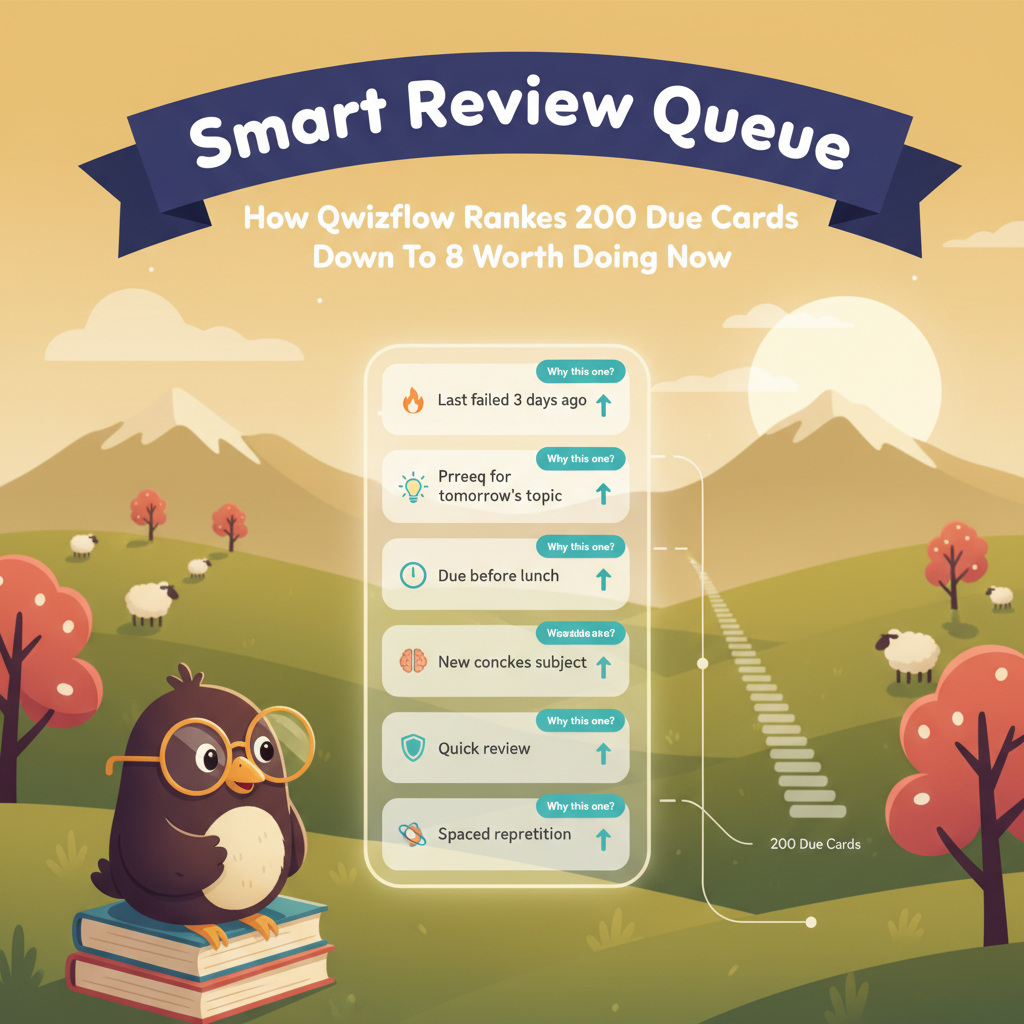
Smart Review Queue: How Qwizflow Ranks 200 Due Cards Down To 8 Worth Doing Now
Hone Tukaki again. Pull up a chair — this is one I've been turning over in my head for a while, and I think it lands particularly well for students.
Today's topic is how qwizflow ranks 200 due cards down to 8 worth doing now — and the angle I want to take is grounded in how Qwizflow's Smart Review Queue handles it. The one-line case for the design: A review stack ranked not by recency but by which cards need you most right now — combining spaced-rep timing, misconception signal, and goal proximity. That's the destination; the rest of this piece is how it earns the claim.
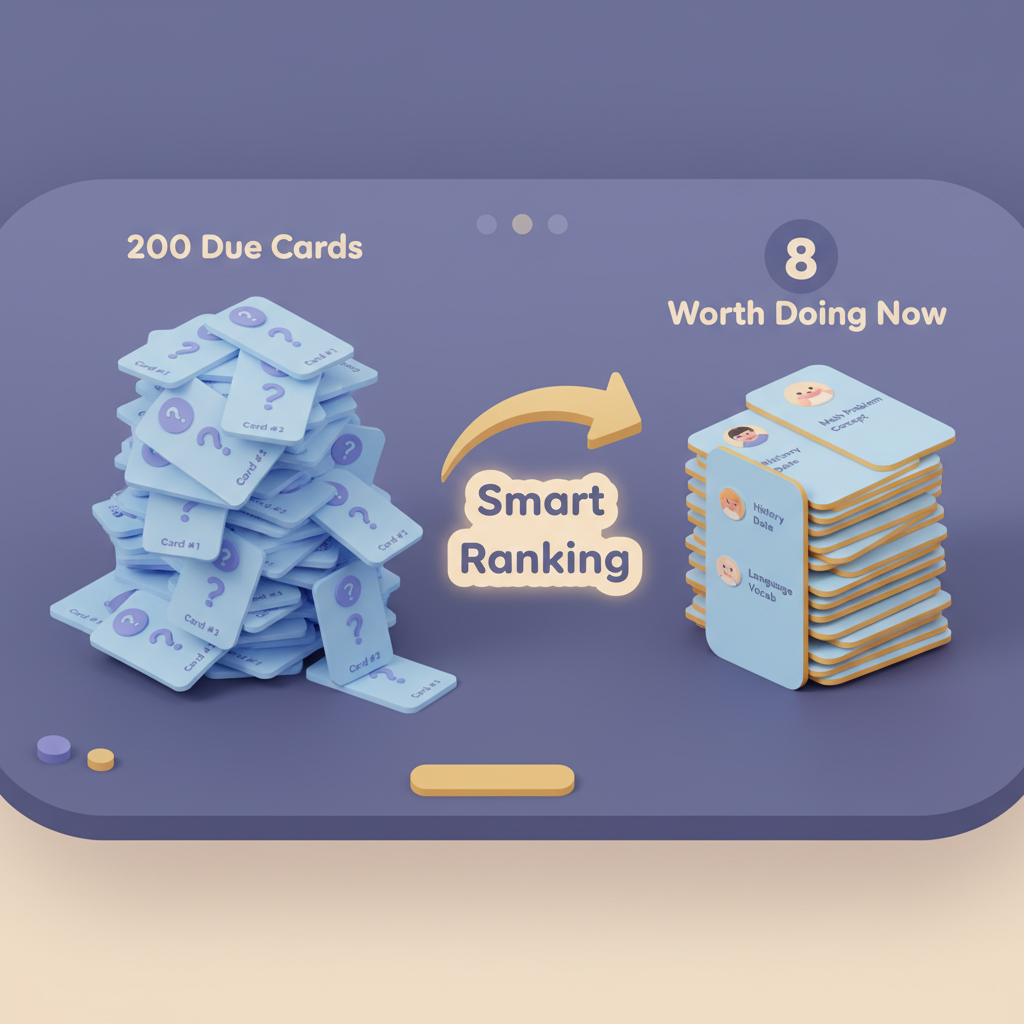
Why Smart Review Queue exists in the first place
Let me start with the bit that surprised me when I first looked into it.
Picture a typical student in New Zealand — the kind of household where Waitangi Day at the marae comes up over the dinner table and NCEA Level 1 prep takes up Sunday afternoon. The familiar frustration: the tooling treats every learner identically, even when the data clearly says they aren't. The cost shows up not as a single dramatic failure but as a slow drift — small misalignments compounding across weeks until a student notices something off.
That's the problem Smart Review Queue is designed for. The framing is honest: A review stack ranked not by recency but by which cards need you most right now — combining spaced-rep timing, misconception signal, and goal proximity. Anchor that to smart review as the underlying concept and the design choices start to make sense.

How Smart Review Queue actually works
The mechanics aren’t magical — they're worth seeing up close.
Mechanically, three components do the work. First, the underlying signal — think of it as the misconception signal layer — is captured continuously rather than at exam-time, which means the system always has fresh evidence of what's working and what isn't. Second, the AI layer reads that evidence in context — content level, current goals, recent affective signal — and only THEN decides what to suggest next. Third, the suggestion is presented as a recommendation, not an instruction; the student stays in the driver's seat.
Worth flagging a related angle here — goal-aware review — cards that matter for what's coming — because that's the most common follow-up question once students see the basic flow. Short answer: the design accounts for it; the longer answer would deserve its own post.
A note on what's NOT happening in this flow: no raw student PII transits to the AI provider; the prompts that DO go out are scrubbed at the boundary; every AI call is logged in the Parent Transparency Ledger so families can audit per-feature usage. These aren't afterthoughts — they're hard architectural constraints baked into how the feature works at all.
What changes for students
Here's what I've watched shift in the students I work with.
The measurable difference: students report shorter time-to-clarity on tricky topics, fewer "where do I even start" moments, and — the one that matters for habit — sessions that end with energy rather than friction. On the priority queue dimension specifically, the effect is more pronounced than I expected when I first tried it.
The qualitative change is harder to measure but easier to notice. In a household in New Zealand, you tend to hear it as "actually that wasn't bad" instead of the negotiation that usually precedes a study session. In a classroom — the kind where Countdown would feel familiar — teachers describe being able to spend more time on the four concepts that need them most, instead of dividing attention thinly across the whole room.
What doesn't change — and this is worth being honest about — is the requirement that the student actually does the work. No AI tool removes that part. The good ones just make the work feel like it's worth doing.
A short note on safety and consent
Qwizflow's posture on AI is designed for families and schools first: every AI feature has a granular consent toggle (in the AI Consent Centre), three age tiers (under-13 / 13-15 / 16+) with parental-override defaults for the youngest, and a transparency ledger that records every AI interaction in plain language. Nothing leaves the device unless the consent gate explicitly allows it, and even then the prompts are PII-scrubbed at the boundary.
Where to find it in Qwizflow
Smart Review Queue sits in the Student surface of the app. The simplest way in: open the dashboard and look for the tile labelled "Smart Review Queue" — first run will walk you through the consent gate (if it's an AI feature), then you're in. Full feature docs and the latest changelog live on qwizflow.com.
Here's what I'd want you to remember a week from now:
A review stack ranked not by recency but by which cards need you most right now — combining spaced-rep timing, misconception signal, and goal proximity — not as a marketing line, but as the design constraint the build kept coming back to. If you're a student in New Zealand, give it a week and see how it lands.
— Hone Tukaki Hone is a New Zealand Pasifika educator and wellbeing-first writer working with whānau across Auckland and the wider motu.
FAQ
What is the Smart Review Queue in Qwizflow?
A review stack ranked not by recency but by which cards need you most right now — combining spaced-rep timing, misconception signal, and goal proximity.
How does Qwizflow decide which review cards matter most?
It combines spaced-repetition timing, misconception signal and goal proximity, so the queue is goal-aware and surfaces the cards that matter for what's coming — not simply the most recent ones.
Is student personal information used to rank review cards?
No raw student PII transits to the AI provider. Prompts are scrubbed at the boundary, and every AI call is logged in the Parent Transparency Ledger so families can audit per-feature usage.
Where is the Smart Review Queue in Qwizflow?
In the Student surface of the app: open the dashboard and look for the tile labelled "Smart Review Queue". The first run walks you through the consent gate, then you're in.
Try Qwizflow free → qwizflow.com
No paywall. Built for students in New Zealand (and beyond). Sign in with Google to get your AI-personalised home in under a minute.
Explore more: How Qwizflow works · Every feature, shown running · For Students